
Modernizing Communications For Mission-Critical Networks
Mission-critical networks are changing fast.
Utilities, transport operators, and critical infrastructure providers are under pressure to deliver more data, more automation, and more resilience—without ever compromising reliability.
The challenge is simple: legacy SDH/SONET networks were built for a different era.
They still deliver reliability.
But they can’t support what comes next.
Drivers for Change
Modern OT (operational technology) networks are being reshaped by three forces:
- Decarbonisation – the need to meet increasingly strict environmental and sustainability targets
- Decentralisation – proliferation of industrial IoT devices and move to a federated cloud model
- Digitalisation – infrastructure, systems, and services are being digitized
These trends are driving a massive increase in:
- Data volumes (CCTV, sensors, IIoT)
- Real-time control and information requirements
- Security and compliance
At the same time, SDH/SONET is reaching end-of-life—and the skills to operate it are disappearing.
Operators are forced to modernize – but need to do it safely
Why “Rip and Replace” Doesn’t Work
Mission-critical networks are different.
You can’t afford disruption. You can’t accept risk. And you can’t compromise deterministic performance.
That means modernisation must deliver:
- The same predictable latency and behaviour as TDM
- The same five-nines availability
- A controlled migration path with zero service impact
This is why the industry is moving toward deterministic packet transport networks (PTN) and circuit emulation.
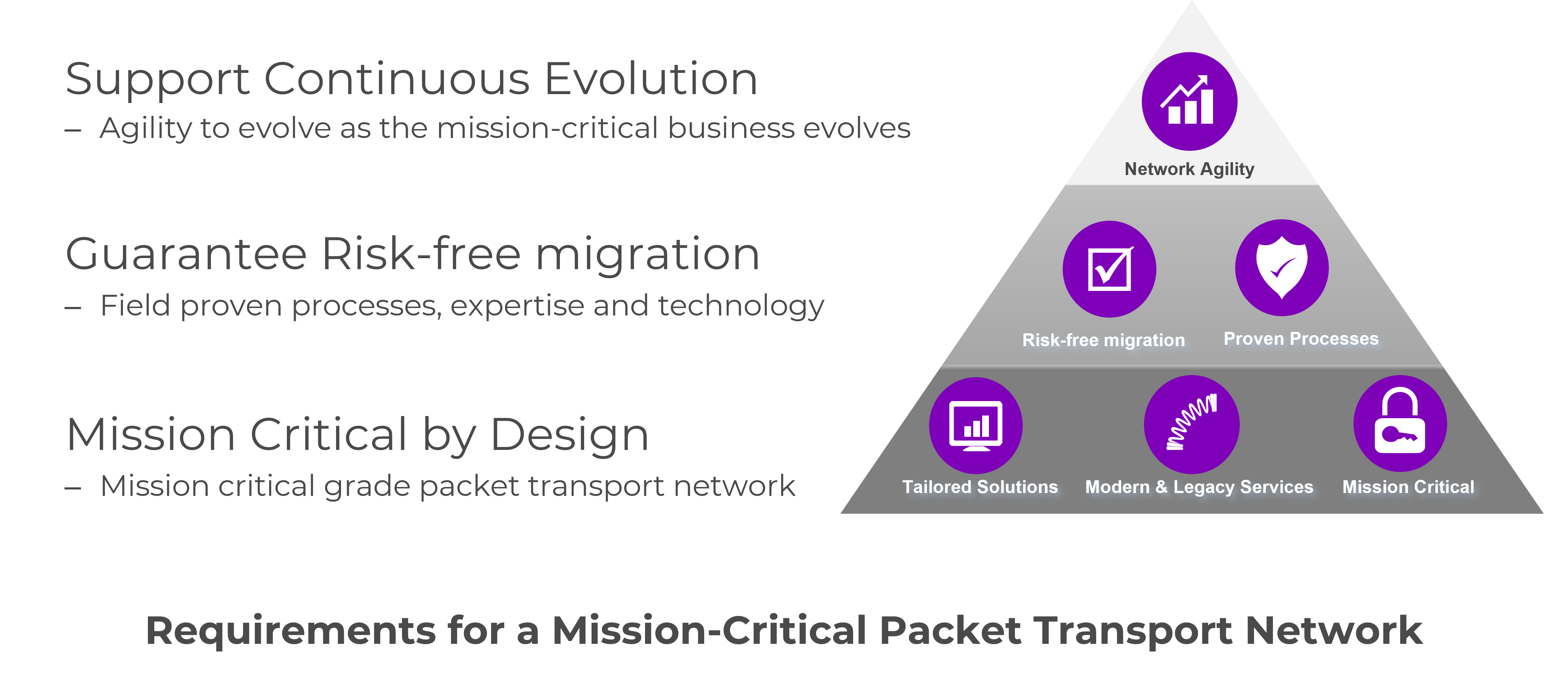
The goal is a mission-critical packet transport network
- Guaranteed Performance
- Engineered, bi-directional paths
- Deterministic latency and jitter
- Predictable restoration behaviour
- Built-in Resilience
- Sub-50ms protection switching
- Dual-homing and link aggregation
- No single points of failure
- Full Service Support
- Legacy services (TDM, serial, teleprotection)
- Modern services (IP/MPLS, Ethernet, EVPN)
- Seamless coexistence
- Integrated IP and Optical
- Efficient scaling to high bandwidth
- Simplified architecture
- Better cost and performance balance
The Critical Success Factor: Risk-Free Migration
The technology is only half the story.
What really matters is how you get there.
Successful modernisation requires:
- Proven, field-tested migration processes
- Support for legacy interfaces during transition
- Phased rollout with full service continuity
This approach allows operators to:
- Upgrade without disruption
- Retire legacy infrastructure gradually
- Maintain full operational control
Building a Future-Ready Network
Modern PTNs are not just replacement transport networks.
They unlock new capabilities:
- Automation at Scale
- Faster provisioning
- Reduced manual errors
- Lower operating costs
- Continuous Evolution
- Introduce new services without redesign
- Scale capacity and functionality over time
- Telco Opportunity
- Monetise excess capacity
- Offer wholesale or retail connectivity services
- Operate as a service provider alongside core operations
What a Modern Architecture Looks Like
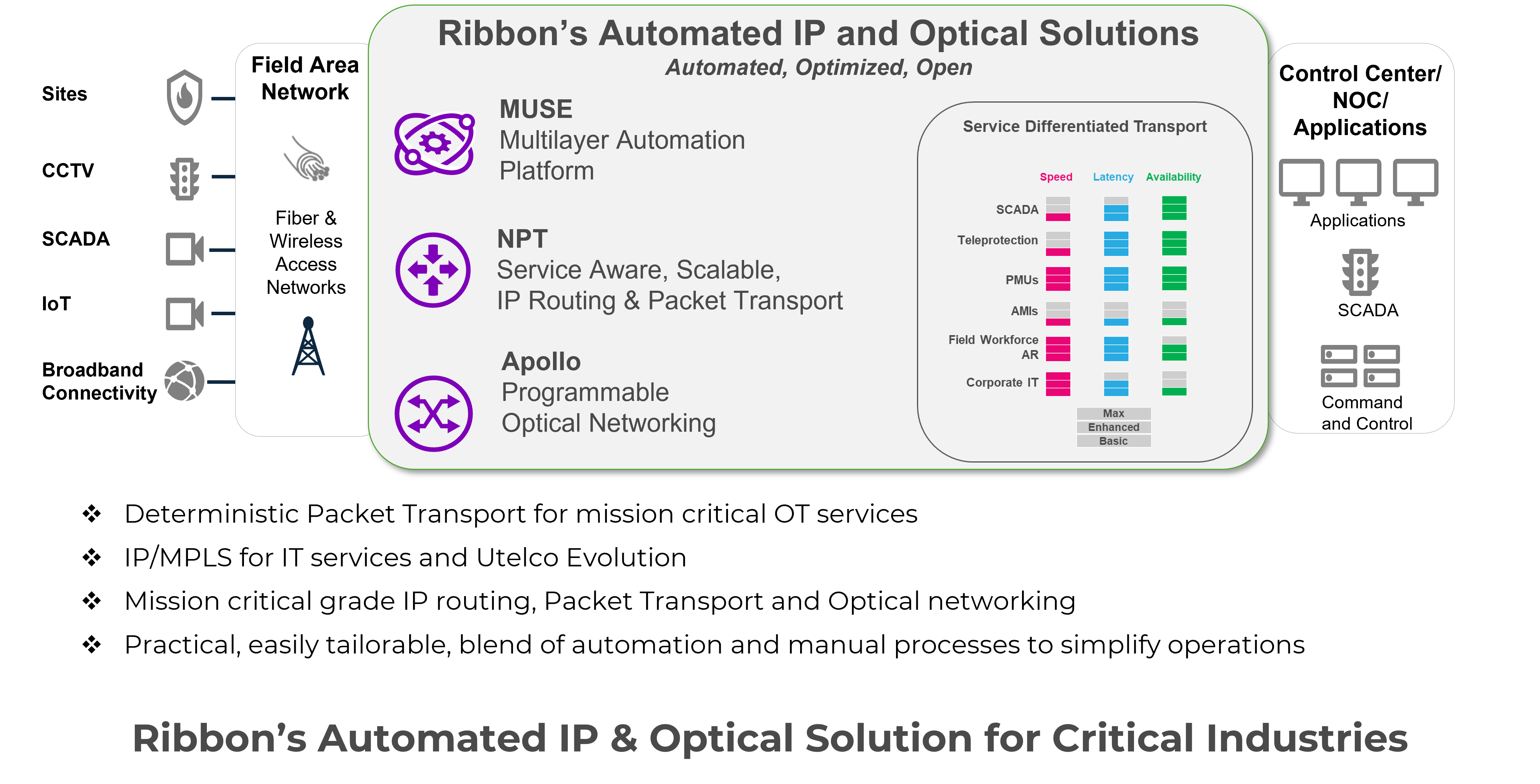
NPT (IP Routing & Packet Transport)
- Service-aware routing
- Multi-service support
- Deterministic packet transport
Apollo (Optical Networking)
- High-capacity programmable optical transport
- Scales to 400G, 800G and beyond
Muse (Automation Platform)
- End-to-end lifecycle automation
- Real-time assurance and analytics
- Controlled balance of automation and manual control
One network that supports both OT and IT—without compromise.
Protecting What Matters Most
Mission-critical services are not equal.
A modern network must prioritise accordingly:
- SCADA and teleprotection: highest priority, deterministic paths
- Operational systems: assured performance
- IT and broadband: best-effort or differentiated services
This is enabled through:
- Hard slicing (dedicated resources for critical services)
- Soft slicing (QoS-based differentiation)
Every service gets exactly the performance it needs.
A Practical Path to Modernisation
The reality is that no two networks are the same.
That’s why modernisation must be:
- Flexible
- Phased
- Tailored to operational requirements
With the right approach, operators can:
- Maintain legacy services during transition
- Introduce IP/MPLS or MPLS-TP based on need
- Evolve at their own pace
The Bottom Line
Modernising mission-critical networks is no longer optional.
But it doesn’t have to be risky.
With the right architecture and approach, operators can:
- Preserve deterministic performance
- Enable digital transformation
- Reduce complexity and cost
- Unlock new business opportunities
An always-on, never-fail network.