
Re-Inventing Network Operations: Are AI Extensions the Right Path?
For decades, telecom network operations have depended on traditional OSS tools – complex, services-heavy platforms that take years to modernize and even longer to deliver measurable business impact. This year at MWC, the leading OSS vendors showcased a variety of new AI extensions for their portfolios and marketed them as the fastest path to autonomous network operations. They are not.
For telecom executives, the real opportunity is far more disruptive: adopting an AI-native platform that combines
- Cross-domain observability
- Real-time data analytics
- Agentic AIOps
- Automation
This is not another OSS upgrade. It is embracing AI-driven automation to fill the gaps in existing OSS tools and reinvent network operations.
The Problem with OSS AI Extensions
Traditional OSS vendors are retrofitting AI into architectures that were never designed for real-time intelligence. They’re adding chatbots and MCP interfaces to legacy tools and introducing new agentic AI-based overlay augmentations that will eventually tie everything together. This approach promises an amazing evolution, but in practice, it results in risky, multi-year transformation programs that rely on complex, customized system integrations.
The results?
- The need to fully integrate across multiple applications for the agentic layer to access key data
- Creating dependence on API depth, potentially limiting real-time performance and decision-making
- Requiring expensive professional services
- Numerous software license updates, which drive up maintenance costs and delay ROI.
- Modest, incremental efficiency gains instead of significant business outcome improvements.
New OSS AI extensions cannot fundamentally change operations because these capabilities still sit atop multiple layers of systems and data models built for swivel-chair, reactive processes, not for real-time, autonomous decision-making.
Ribbon Acumen, the AI-Native Alternative for OSS
Ribbon’s Acumen platform starts with a different premise: real-time data analytics as the foundation for agentic AI-driven automation, not an afterthought.
Cross-domain observability and robust data analytics are at Acumen’s core – providing real-time ingestion, enrichment, and analysis of telemetry, events, logs, topology, performance, security, and application data from any mix of network devices and existing systems. Instead of siloed domains, our customers gain a unified, streaming data layer (see Figure 1).
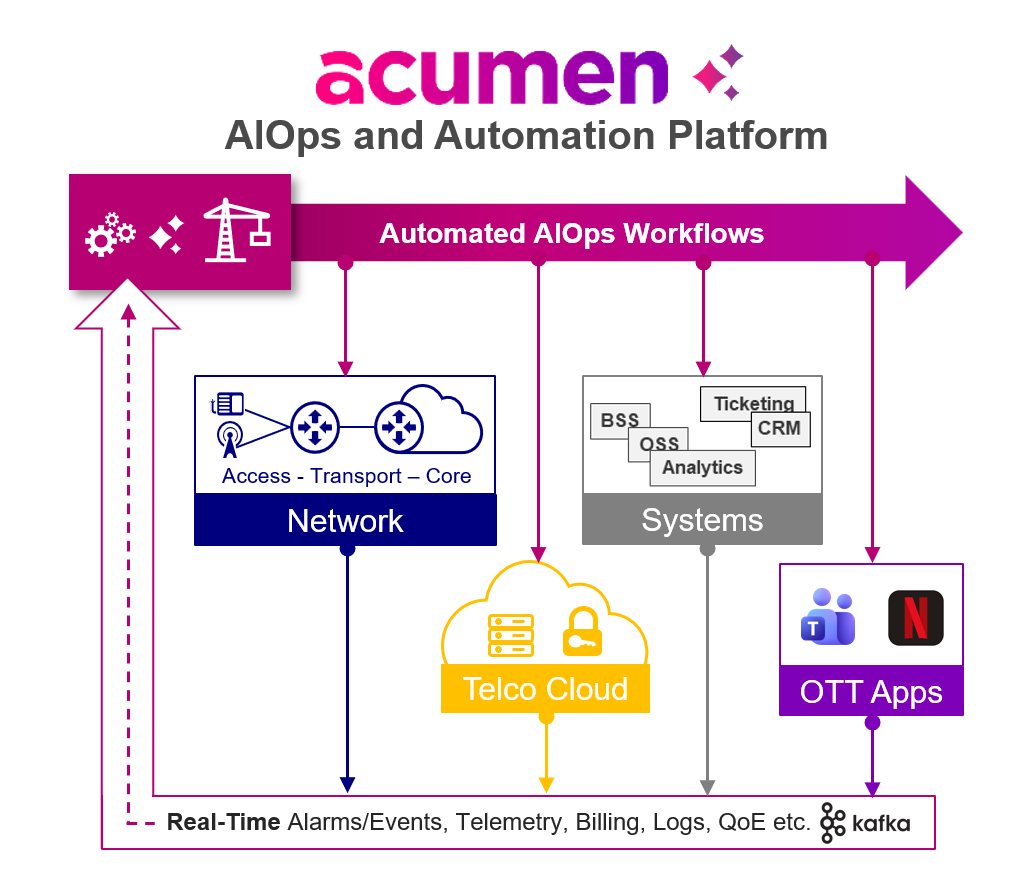
Figure 1: Acumen’s Approach to Autonomous Network Operations Leveraging Real-time Data
Low-code/No-code AIOps Customization
Acumen Builder, our intuitive, AIOps workflow engine, sits on top of this foundation of real-time observability and analytics and leverages:
- Machine learning for anomaly detection, prediction, and optimization
- Generative AI to contextualize issues and guide operational processes
- Agentic AI to create and autonomously execute closed-loop AIOps workflows
This is where the model shifts.
From Multiple Dashboards to Autonomous Network Operations Workflows
In traditional environments, operations teams pivot between dashboards, swivel across tools, and manually coordinate key operational processes, including remediation. With existing OSS, even “automated” workflows are siloed and pre-scripted because they aren’t based on real-time data.
As an AI-native platform, Acumen enables more dynamic, context-aware automation. Our VP of Systems Architecture for Acumen, Chip Boyle, showcased Acumen’s autonomous networking and predictive maintenance approach to customers at MWC last week. As Chip demonstrated, cross-domain degradation can be detected in seconds. The root cause can be analyzed and correlated across network, cloud, and IT layers in minutes. From there, an automated operational workflow can remediate the issue in a closed loop.
For our customers, this translates directly into measurable outcomes:
- Faster mean time to repair (MTTR) and reduced operational expense
- Improved service availability and SLA compliance
- A better customer experience and lower churn
- Accelerated service introduction and monetization
These aren’t just incremental efficiency improvements; they’re the foundation for structural change.
Speed to Business Value
Perhaps the most important distinction is speed.
Multi-year OSS transformation programs consume capital before producing results. They heavily rely on custom integrations, professional services, and phased migrations. By the time they stabilize, the business requirements have often shifted.
As an AI-native, multi-vendor platform, Ribbon Acumen is built on open APIs and real-time data. It can overlay existing systems and begin delivering value within months versus years. This solution does not require a rip-and-replace. Instead, it can help operators fill gaps in their deployed OSS tools and gradually reduce their operational necessity.
This approach, combined with Acumen’s intuitive low-code/no-code user interface, enables a radically different investment strategy:
- Lower upfront dependency on services
- Faster time-to-automation
- Step-by-step autonomous network evolution that is aligned with business priorities
- Measurable ROI tied to operational KPIs
For telecom executives under pressure to demonstrate the impact of AI-driven automation while protecting margins, the choice is clear: prioritize AI extensions to existing OSS tools and accept modest incremental gains, long timelines, and services-heavy programs. Or adopt an AI-native platform like Acumen that unifies observability, real-time analytics, and low-code/no-code agentic AIOps into an automated operational fabric that delivers faster business outcomes, lower operational costs, and a sustainable competitive advantage.
The next generation of network operations will not be built by upgrading yesterday’s OSS tools. It will be realized by reinventing the operating model altogether.