
Materiality
Our Approach to Materiality
Overview
Stakeholders are defined as groups (or individuals) that can reasonably be expected to be significantly affected by a company’s activities, products and services, or whose actions can reasonably be expected to affect the ability of the organization to successfully implement its strategies and achieve its objectives.
Material topics are those that represent Ribbon’s most significant economic, environmental and social impacts and/or topics that substantially influence the assessments and decisions of stakeholders. It is important to define the material impacts of a business to focus sustainability activities on what matters most to gain the best outcomes for the business and for society, as well as to gain an early understanding of potential areas of business risk and opportunity.
Double Materiality combines impact-based materiality with sustainability-related financial materiality. It assesses both the broader effects of our activities on the economy, environment and society (outward facing) and the actual or potential risks to our ability to create value over time because of external environmental or social matters (inward facing). This combination provides stakeholders with a comprehensive view of the most significant topics affecting our overall business performance, impacts, risks and value-creation ability.
Assessing materiality and defining key material sustainability topics through a Double Materiality Assessment (DMA) helps identify and prioritize the sustainability issues that matter most to our business and stakeholders. A materiality assessment analyzes inputs from internal and external stakeholders along with global sustainability trends and topics, enterprise strategy and risk assessment to form a specific set of priorities that should be considered in business and sustainability strategy development and disclosure (reporting).
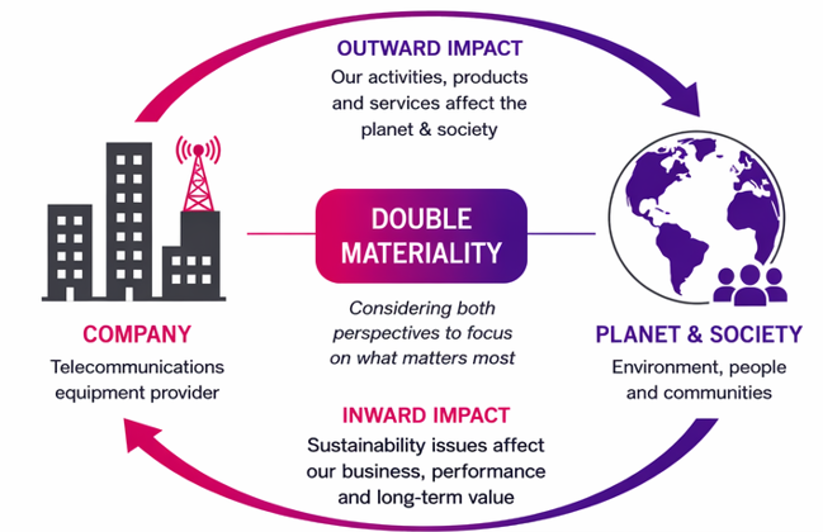
Typically, a DMA includes, aggregates and prioritizes a range of information from different sources, including but not limited to:
- Business strategy and capabilities
- Enterprise risk assessments
- Employee concerns and expectations
- Customer expectations
- Regulatory frameworks
- Global sustainability trends
- Voluntary sustainability disclosure standards and mandated disclosure requirements
- Investor disclosure demands
- Material priorities and disclosures from peers, competitors, customers and suppliers
- Management evaluation of relative importance of the impacts on society and the environment AND the relative strength of stakeholder concerns
Our Approach
Ribbon is committed to following a strategic approach to sustainability and strives to continuously improve its contribution to sustainable development while minimizing areas of negative or potentially negative impact. At the same time, Ribbon believes that managing sustainability proactively can help Ribbon identify opportunities to improve its impacts on society and the environment and deliver sustainable business growth, while gaining an understanding of potential sustainability risks.
Therefore, Ribbon undertakes to define and prioritize sustainability topics in a structured process that can serve as a basis for strategy development, action planning, resource allocation, stakeholder engagement and sustainability communications. Sustainability topics defined as material are incorporated in our sustainability strategy and targets. Non-material sustainability topics remain on our radar in case of future changes, and we strive to maintain performance in these areas in line with overall expectations of our stakeholders.
Material sustainability topics are generally complex, strategic topics that retain their relevance and importance over several years. We undertake to conduct a full materiality assessment every 5 years, with annual reviews and modifications considering strongly emerging trends or changes in our business. We conducted our first impact materiality assessment in 2021. We subsequently concluded our first full Double Materiality Assessment in 2024.
Double Materiality Assessment (DMA)
Our DMA followed a structured process, involving management review and approval at each stage.
Stakeholder engagement
At Ribbon, we welcome feedback at all levels of the organization to help us understand the needs of stakeholders and position ourselves to respond effectively.
| Ribbon’s Key Stakeholder Groups | ||
|---|---|---|
|
|
|
We re-engaged with stakeholders in various ways to reaffirm our understanding of their perspective and expectations of Ribbon in our rapidly evolving world. Their responses contributed to the development of our DMA. See Our Approach to Stakeholder Engagement.
We continue to track the queries we receive from our global customer base that relate to sustainability topics ranging from climate change mitigation through to health and safety, human rights and more. In 2024, we received the highest number of queries since our tracking started more than 13 years ago – an increase of 30% compared to 2023. These customers represent more than 85% of our revenues, reflecting the high interest in sustainable practices from this stakeholder group.
| Top 10 Sustainability-Related Queries from our Customers | |
|---|---|
| Business Continuity Planning | Scope 3 GHG Emissions |
| Ecovadis Score | Health and Safety |
| Environmental Management System | Science-based Targets |
| Carbon Footprint | Responsible Supply Chain |
| Facilities Security | Net Zero Ambition and Plans |
With these stakeholders in mind, we gathered additional input to inform our overall analysis of the relevant universe of sustainability topics for Ribbon.
Developing a universe of sustainability topics
We analyzed and aggregated the expectations of global stakeholders a broad range of standards, frameworks, trends, disclosures and direct inputs from a range of external and internal sources as follows:
| DMA Input Sources in 2024 | |
|---|---|
| Public disclosures from 12 customers | 8 leading sustainability standards and disclosure frameworks |
| Public disclosures from 13 competitors and peers | Insights received by Ribbon from investment analysts |
| Global and industry trends from 3 sources | Ribbon 2023 Enterprise Risk Management summary |
| Stock market disclosure requirements from 1 source | Insights from Ribbon managers and leaders across all functions and geographies |
This analysis of multiple sources yielded more than 600 identified topics, many of which were similar. We collated and combined similar topics, reducing the list to some 150 topics, which we then evaluated and prioritized in detail using explicit criteria and rankings.
Prioritizing sustainability topics
For each topic, we assessed both Impact Materiality and Sustainability-related Financial Materiality, using the criteria listed below.
| Criteria for Analysis and Prioritization of DMA Topics | |
|---|---|
| Impact Materiality | Sustainability-related Financial Materiality |
| Scale (gravity of impact) | Probability of risk |
| Scope (spread of impact) | Scale of financial damage |
| Irremediability (possibility of reversal to prior state) | Scale and degree of financial opportunities |
| Overall likelihood of the impact occurring | Enterprise Risk Management results where relevant |
All the criteria above were scored on a high-medium-low scale, with specific evaluation criteria established for each topic at each level of the scale. The timescale for all risks was medium-term, and positive/negative and actual/potential filters were used to create a balanced and realistic result. Financially material topics were reviewed against our robust annual Enterprise Risk Management process and results, and evaluation thresholds were aligned accordingly.
The assessment resulted in ten topics that were evaluated as material from both an impact and a sustainability-related financial standpoint. These topics were reviewed and discussed in a leadership workshop with representatives from all Ribbon functions, building on their specific knowledge of our business impacts and stakeholder interests.
Several topics that fell below the materiality threshold continue to be on our radar and remain part of our overall sustainability plans and performance. These topics include, for example, water conservation and community impacts, and we continue to track, improve where possible, and disclose on these topics.
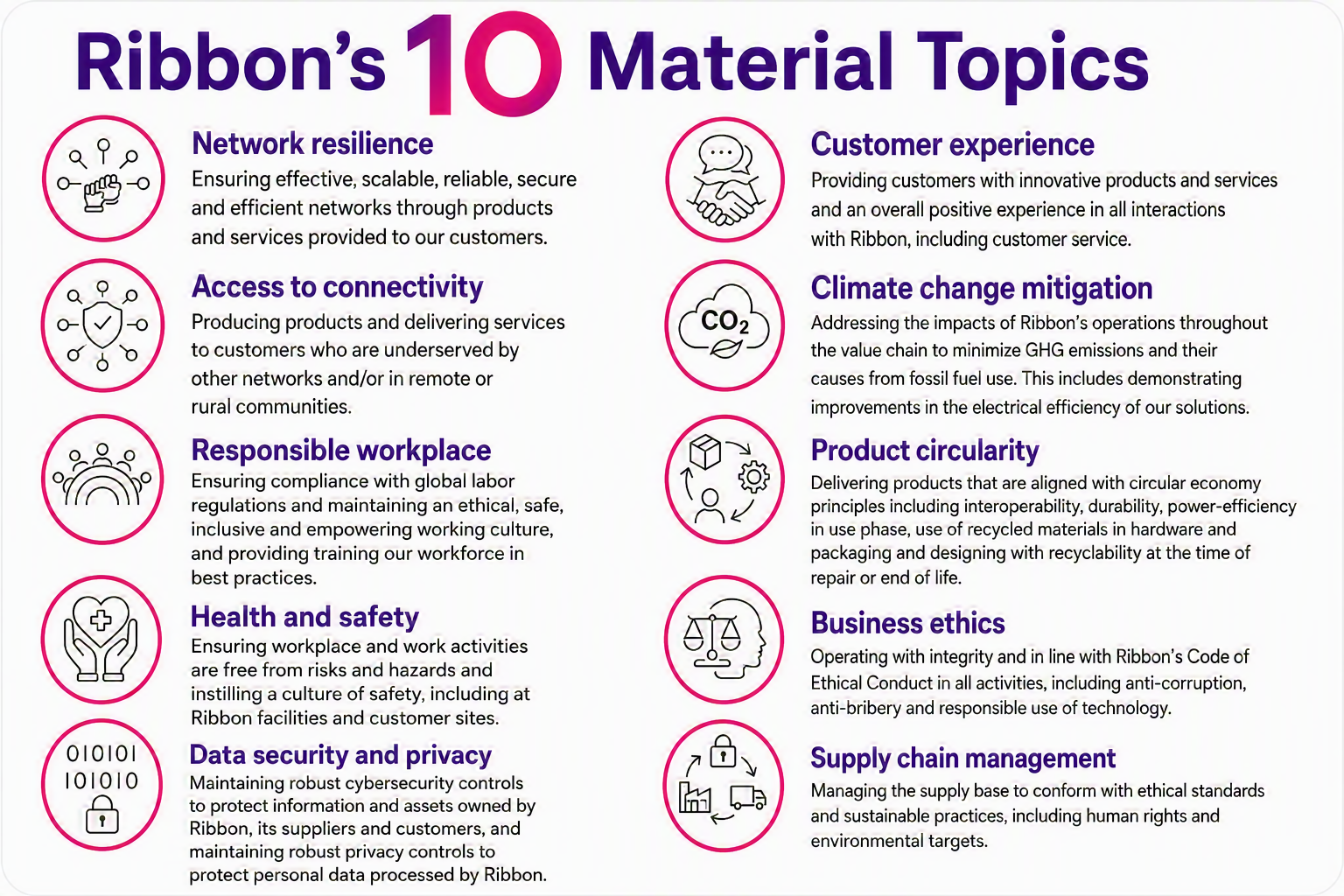
Material Topics (see Figure 1)
| Ribbon’s 10 Material Topics | |
|---|---|
| Network resilience: Ensuring effective, scalable, reliable, secure and efficient networks through products and services provided to our customers. | Customer experience: Providing customers with innovative products and services and an overall positive experience in all interactions with Ribbon, including customer service. |
| Access to connectivity: Producing products and delivering services to customers who are underserved by other networks and/or in remote or rural communities. | Climate change mitigation: Addressing the impacts of Ribbon's operations throughout the value chain to minimize GHG emissions and their causes from fossil fuel use. This includes demonstrating improvements in the electrical efficiency of our solutions. |
| Responsible workplace: Ensuring compliance with global labor regulations and maintaining an ethical, safe, inclusive and empowering working culture, and providing training our workforce in best practices. | Product circularity: Delivering products that are aligned with Circular Economy Principles including interoperability, durability, power-efficiency in use phase, use of recycled materials in hardware and packaging and designing with recyclability at the time of repair or end of life. |
| Health and safety: Ensuring workplace and work activities are free from risks and hazards and instilling a culture of safety, including at Ribbon facilities and customer sites. | Business ethics: Operating with integrity and in line with Ribbon's Code of Ethical Conduct in all activities, including anti-corruption, anti-bribery and responsible use of technology. |
| Data security and privacy: Maintaining robust cybersecurity controls to protect information and assets owned by Ribbon, its suppliers and customers, and maintaining robust privacy controls to protect personal data processed by Ribbon. | Supply chain management: Managing the supply base to conform with ethical standards and sustainable practices, including human rights and environmental targets. |
Aligning material topics to reporting standards
We mapped our material topic to the GRI Reporting Standards for the purposes of sustainability disclosure.
| Material Priority | GRI Standards | GRI Topic-Specific Disclosures |
|---|---|---|
| Network Resilience | GRI 203: Indirect economic impacts 2016 | 203-2 |
| Access to connectivity | GRI 203: Indirect economic impacts 2016 | 203-2 |
| Responsible workplace | GRI 401: Employment 2016 | 401-1 |
| GRI 404: Training and Education | 404-1 to 404-3 | |
| GRI 405: Diversity and Equal Opportunity | 405-1 | |
| Health and safety | GRI 403: Occupational Health and Safety 2018 | 403-1 to 403-10 |
| Customer Experience | GRI 3: Material Topics 2021 | GRI Topic-Specific Standard not available. Ribbon proprietary metric used to measure performance in this area. |
| Climate change mitigation | GRI 302: Energy 2016 | 302-1, 302-3 |
| GRI 305: Emissions 2016 | 305-1 to 305-4 | |
| Product circularity | GRI 302: Energy 2016 | 302-5 |
| Business ethics | GRI 205: Anti-Corruption 2016 | 205-3 |
| GRI 419: Socioeconomic Compliance 2016 | 409-1 | |
| Data security and privacy | GRI 418: Data privacy 2016 | 418-1 |
| Supply chain management | GRI 414: Supplier Social Assessment 2016 | 414-1 |
Aligning material topics to the SDGs
The following table shows how our materiality-based approach supports relevant United Nations Sustainable Development Goals (SDGs) and targets.
| Material Clusters and Topics | SDG | SDG Relevant Targets |
|---|---|---|
Networks and People
|   |
|
Climate and Nature
|   |
|
Responsible Business
| |
|
Governance
Executive direction of our approach to Materiality is led by Ribbon’s Executive Vice President and Chief Legal Officer.
The outcome of the DMA and the discussions prioritized the ten topics to be material both from an impact materiality and sustainability-related financial materiality perspective. The results of the materiality assessment were approved by our Executive Team, presented to the NSCG Committee and supported by the Board of Directors.
Disclosure
We provide public transparency regarding Ribbon’s approach to Materiality in our annual Sustainability Report, available on our website.
Figure 1. Ribbon’s 10 Material Topics
Version 3.0 Aug 2026