G5 Seamlessly Integrates Legacy Analog with Modern SIP
Legacy Doesn’t Mean Obsolete
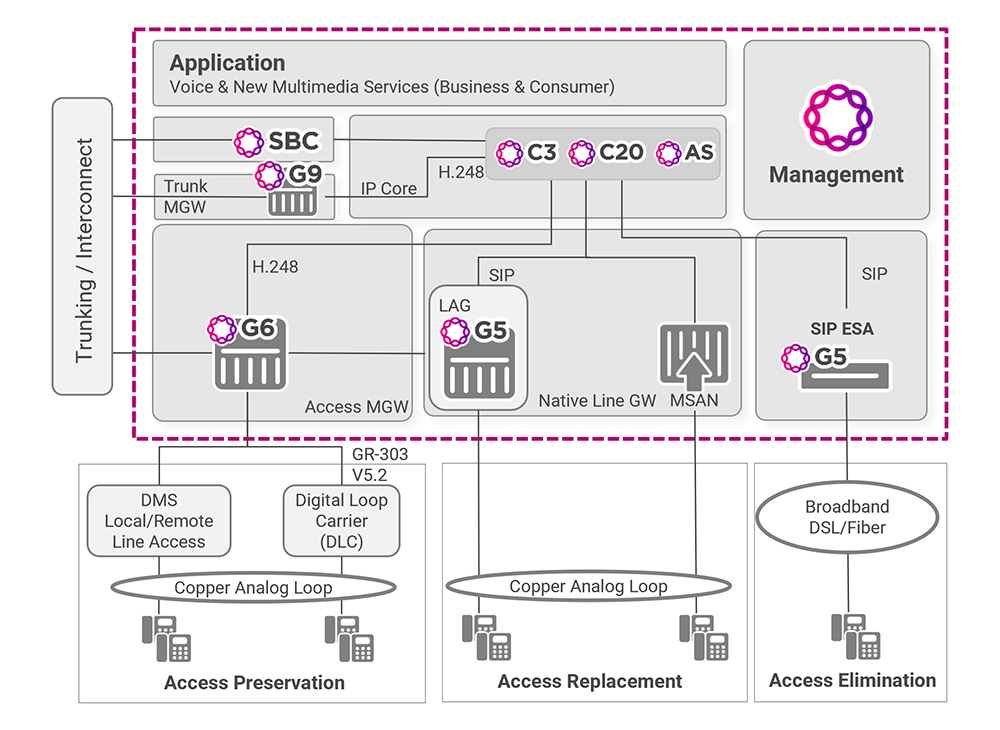
Voice over broadband and mobile offerings may represent the future but in many environments copper loops still have an important role to play and represent an important revenue stream and customer satisfaction. Service Providers can leverage a modern IP core for lower operational costs and newer services, without impacting existing business. This hybrid approach offers service providers a bridge to newer technologies without casting off their existing investments.
Easing The Transition from TDM to IP
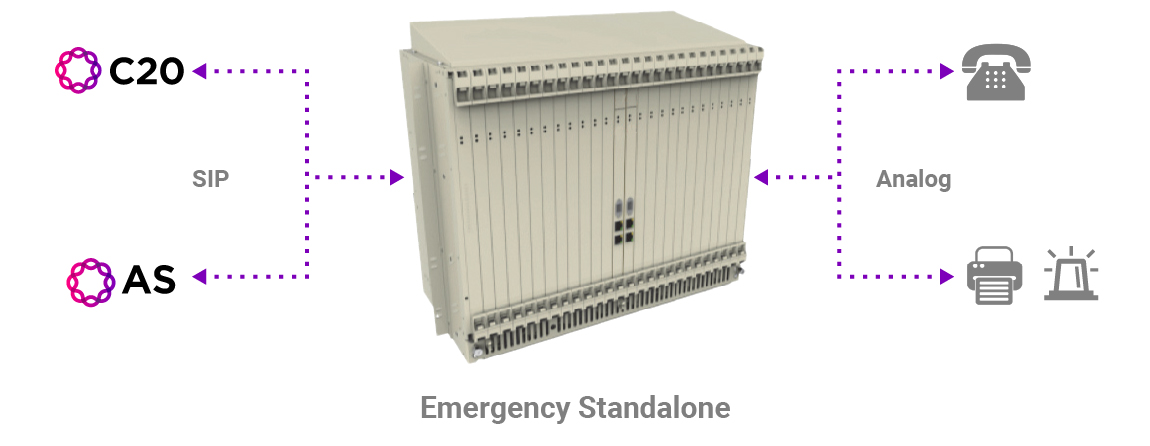
The G5 Line Access Gateway is pivotal in seamlessly transitioning from outdated TDM switches to an all-IP core – without disrupting end-user services. Service providers can retain their last mile copper, retain revenue and meet their regulatory obligations while dramatically reducing power and space requirements. The Emergency Standalone services also make it possible to risk costs by centralizing switching infrastructure without jeopardizing emergency services.
Lowering Power Consumption with a G5
A G5 is not only economical in terms of initial expenditures, it continues to deliver savings over legacy digital line carriers (DLCs). Operating at a power profile of only 0.25 watts per subscriber, the G5 can literally pay for itself in short order. As energy prices continue to skyrocket, the value proposition for the G5 continues to improve, delivering more savings month over month.

Robust Management Features
The comprehensive management capabilities of the G5, including CLI, TL1, and web-browser GUIs, provide service providers with detailed oversight of system performance and troubleshooting. This management flexibility speaks volumes about providers’ ability to minimize downtime and continuously optimize service quality for their customers.

G5 Line Access Gateway Benefits
- Links end customers served by legacy lines to the revenue-generating SIP services cloud, IMS, and mobility
- Replaces TDM switch line frames while leveraging existing copper facilities
- Economical alternative to expensive FTTx upgrades
- Combined with G9 or G6 gateways, enables full TDM switch line and trunk replacement
- Connects to Call Session Controllers like Ribbon's C20 and other IMS-based controllers
- Preserves premises-based analog loops in the enterprise while enabling a new IP-centric services environment
- Carrier grade, high-density analog line termination supports long loop lengths and ESA
- Substantially reduces power, floor space, and maintenance costs
- NEBS level-3 (GR-63-CORE, GR-1089-CORE)
- Emissions Compliance: FCC, 47 CFR 15, Subpart B, Class A
Request a Gateway Quote
Resources
Datasheet
G5 Service Provider Line Access GatewayPress Release
Verizon Network TransformationRelated Pages
G5 FAQ'S
What is the G5 Line Access Gateway?
The G5 Line Access Gateway is a high-density, carrier-grade platform that provides analog line access and enables migration from copper-based networks to SIP-based IP architectures.
What types of networks use the G5 Line Access Gateway?
The G5 Line Access Gateway is used in service provider networks that maintain copper access infrastructure while transitioning to IP, IMS, broadband, and mobile voice services.
How does the G5 support legacy copper networks?
The G5 provides high-density analog line connectivity and allows legacy copper loops to connect to modern IP cores without replacing the access plant.
What role does Emergency Standalone (ESA) play in the G5?
Emergency Standalone (ESA) allows the G5 Line Access Gateway to maintain basic calling services if centralized call control becomes unavailable.
Who uses the G5 Line Access Gateway?
The G5 Line Access Gateway is used by service providers modernizing legacy TDM access networks while maintaining service continuity and regulatory obligations.