AvidThink Telco Cloud and Edge Report 2023
Next-generation foundations for communications workloads
Choices - Cloud-Native or Virtual Deployment Options

Ribbon’s PSX supports two deployment models – the PSX CNe in a cloud-native environment or the PSX SWe in a virtual environment. Both deliver the same extensive full suite of policy and routing services, with a highly scalable and reliable architecture. It is just a matter of preference where a customer wants to deploy. For example, when deployed as a BGCF in an IMS network, to support 5G voice services, a mobile network operator may want to use the same cloud-native infrastructure they have already invested in for the rest of their 5G Core. Alternatively, a service provider who has multiple SBCs deployed in their private cloud will want to re-use that infrastructure for their PSX SWe deployment.
Call Trust® Identity Assurance Services
Policy and Routing for Identity Assurance
PSX CNe and PSC SWe provide an integral component of Ribbon’s Call Trust solution that provides Identity Assurance services:
- STIR/SHAKEN
- Reputation Scoring Service
Policy and Routing functionality enables for our service provider customer’s implementation of STIR/SHAKEN, interworking with Ribbon’s SBCs and Gateways and with any vendor's STIR/SHAKEN-defined Secure Telephone Identity to handle caller authentication or verification request queries and responses.
PSX SWe and PSC CNe can act as a “broker” in real-time, for every call, handling caller identity and call reputation queries and responses for Ribbon’s cloud-hosted STIR/SHAKEN as a Service and its Reputation Scoring Service
Learn More About QoS Routing
Least Cost Routing, QoS Routing and Number Translation Services
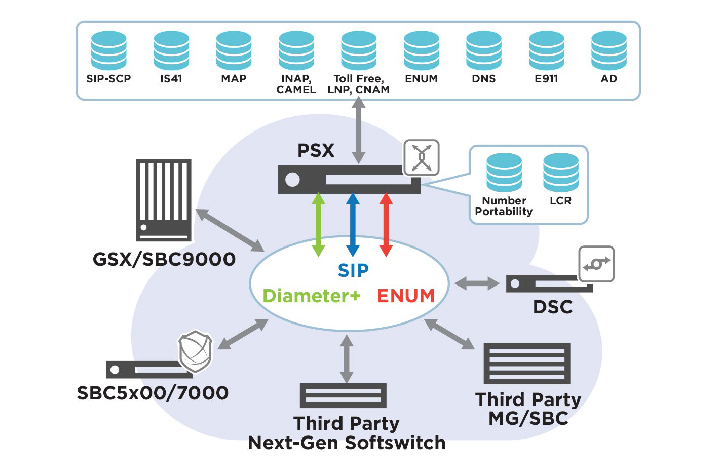
Ribbon's PSX delivers an enhanced Least Cost Routing (LCR) application enabling service providers to reduce costs and increase the quality of service by selecting the most appropriate SIP session routes based on a variety of criteria including interconnect carrier rates, service level agreements, voice quality, latency, and network capacity. Because of the complexity of LCR calculations and the number of variables involved, this decision-making process has traditionally employed teams of analysts or been addressed by LCR engines. Instead, the PSX's LCR application is offered as a highly scalable and flexible solution that works seamlessly with Ribbon, or 3rd party, session border controllers (SBCs). The LCR application aggregates pricing and customer information from back-office systems and combines it with near real-time SIP session metrics provided by Ribbon network analytics software to optimize policy decisions.
If you want to find the shortest path between two points, simply draw a straight line. If, however, you want to find the path with the lowest cost AND the best quality of service (QoS), it can be anything but simple and straightforward. By combining PSX and Ribbon Analytics, we can offer QoS Routing making it possible to find the best combination of cost and quality when determining a routing path. With QoS routing a service provider gains a competitive advantage to be the first choice for routing SIP interconnect and access trunk traffic.
When network operators support number portability services it costs them a very small fee to “dip” into a third-party number portability database for an address. Although the fee may only be a fraction of a penny for every dip, if you handle millions of calls these number translation fees add up fast. Fortunately, with the PSX there is a better way - host your own number translation server. PSX's number translation application enables carriers to deploy a number portability server in-house, reducing costs and decreasing per-call latency incurred from external 3rd party database dips. Like LCR, it is a highly scalable, highly flexible solution. The number translation application supports interoperability with multiple databases using SIP, ENUM, INAP, and TCAP allowing service providers to get number portability data directly from the source.

Request a Policy and Routing Quote
Related Pages
FAQ'S
What is Policy and Routing Server?
Policy and Routing Server helps service providers to centrally manage call routing, session admission control, and network policy decisions across fixed, mobile, and IMS networks using a distributed, highly scalable architecture.
What types of networks can the Ribbon Policy and Routing server support?
The Ribbon Policy and Routing Server can be deployed in fixed, mobile, and IMS network environments and supports service provider networks that require centralized policy control with distributed execution.
How is the Ribbon Policy and Routing Server deployed?
The solution is implemented as software-only and supports both cloud native and virtualized deployment across private datacenters and public cloud environments.
What functions does the Ribbon Policy and Server control?
The Ribbon Policy and Routing Server controls functions such as routing path selection, priority handling, admission control, number translation, call screening, and IMS Border Gateway Control Function (BGCF) operations.
What benefits does policy and routing server provide service providers?
Policy and routing server provides centralized provisioning that allows service providers to manage routing and policy logic from a single point while distributing decision-making across the network, reducing operation complexity and cost.