
Service Providers Who Trust Ribbon

Nasstar

1 Global

Claro
Network-to-Network Interconnect
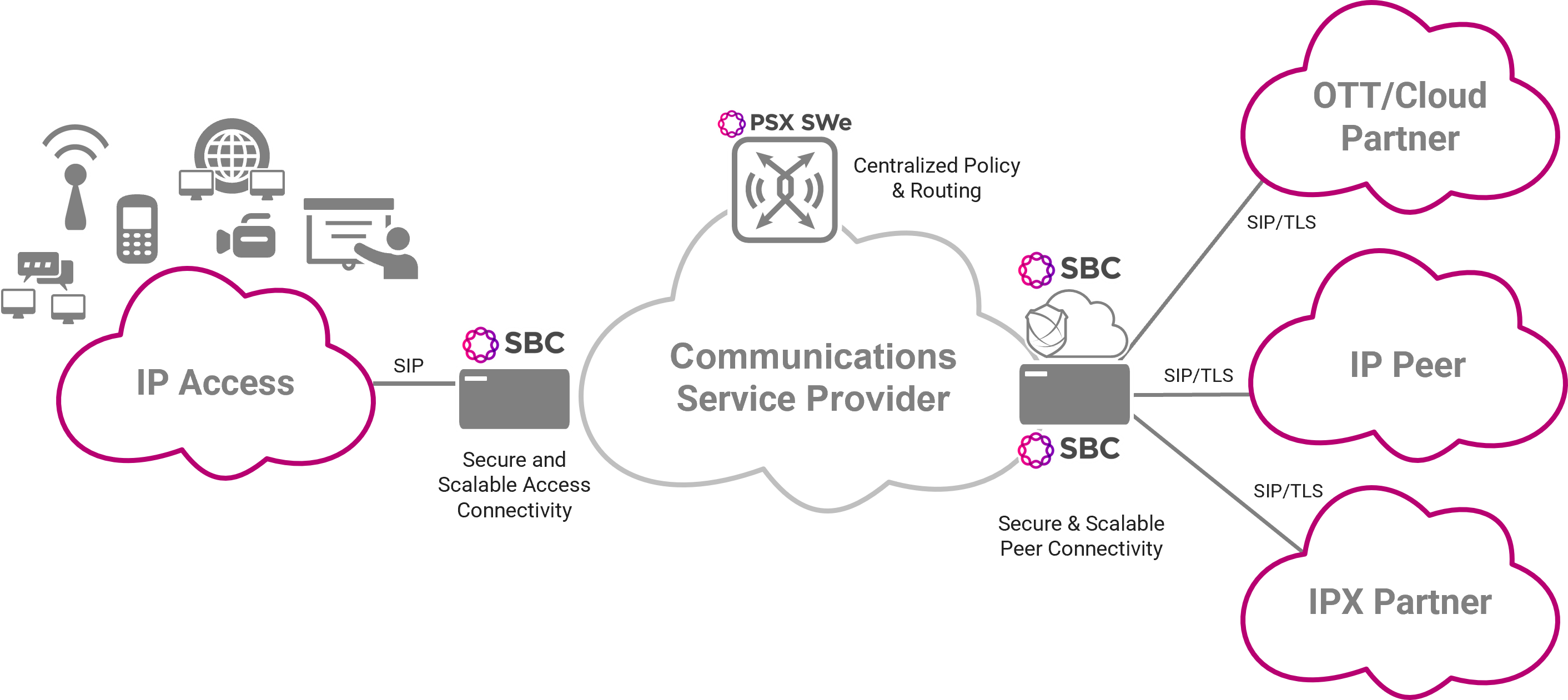
SIP Trunking for network-to-network interconnection is the industry norm because of its ability to scale, inherent cost advantages, extended service reach, and proven resiliency. Ribbon enables high-scale IP peering with its proven carrier-class session border controllers (SBCs) and policy and routing (PSX) solution. Ribbon’s SBCs are highly scalable — enabling seamless interoperability, security, and QoS assurance between disparate IP networks — and are typically deployed in high-availability configurations to ensure service reliability. Ribbon’s PSX provides centralized policy and routing to simplify the complexity and cost of routing calls, using a high-availability master database that replicates to localized databases for processing.
Ribbon’s wide-ranging solution supports VoIP, VoLTE, HD Voice, Full HD Voice with Enhanced Voice Services (EVS), media transcoding for multiple codecs, video, IM, presence, and RCS services.
Cloud Native, Virtual, or Hardware – Your Choice
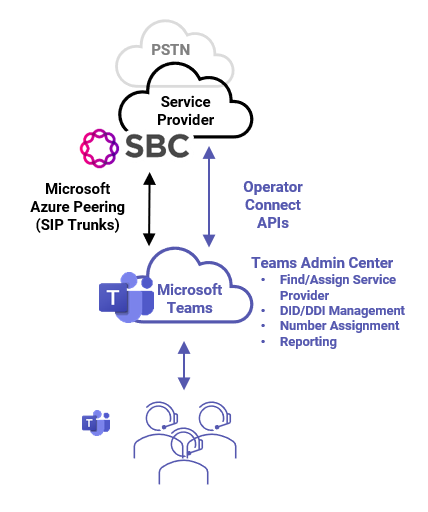
With more and more communications services being deployed in private or public clouds, network-to-network connectivity now includes cloud-to-cloud connectivity. Microsoft Operator Connect is one example: it connects a network operator’s cloud to Microsoft Azure to provide SIP trunking for Microsoft Teams deployments. Ribbon’s SBCs are certified for Operator Connect and ideally suited to support the high volume of encrypted calls across a carrier-grade IP connection.
Network To Network Interface Solutions
Resources
Brochure
Network to Network InterconnectRelated Pages
Network to Network Interconnect FAQs
What is the difference between SIP trunking and SIP NNI?
SIP trunking is the SIP-based transport of communications sessions. SIP NNI is the service-provider interconnection case, where separate networks exchange traffic. Enterprise SIP trunking usually connects one organization’s communications system to a carrier; SIP NNI connects carrier, wholesale, IPX, mobile, fixed, or cloud network domains.
Why does a service provider use an SBC for network interconnection?
A service provider uses a session border controller at the interconnect boundary to secure and control signaling and media, normalize differences between networks, enforce admission policy, and support quality management. The exact functions depend on the SBC, software release, licenses, and deployment design.
How do an SBC and a centralized policy server work together?
The SBC enforces signaling and media controls at the network boundary. A centralized policy and routing platform decides how sessions are authorized and routed across interconnect locations. The split keeps decision logic consistent while session enforcement stays local.
Can SIP NNI connect private and public cloud communications networks?
Yes, when the architecture provides compatible SIP connectivity, security, routing, resiliency, and operational controls. Product eligibility, cloud support, and certification should be verified for each platform and deployment model before you rely on it.
Which services can pass across a SIP network interconnection?
A SIP interconnection can carry supported voice, video, messaging, presence, and rich communications traffic. Actual support depends on endpoint and network capabilities, codecs, signaling profiles, policy, licenses, and the interworking functions in the deployed architecture.