
From Watching AI Search to Engineering for It: What Q1 2026 Taught Us About Real Digital Demand
Last quarter, I wrote about how AI-driven search trends reshaped my digital marketing strategy in ways I hadn’t seen in two decades. At the time, the story was mostly observational: traffic patterns were changing, conversions were holding, and AI-generated search answers were clearly influencing buyer behavior.
Fast-forward to the first quarter of 2026, and one thing is clear — this shift didn’t slow down; it accelerated. But more importantly, it forced us to stop simply reacting to AI search and start engineering for it.
The Metric That Changed Everything: Server Traffic vs. Human Traffic
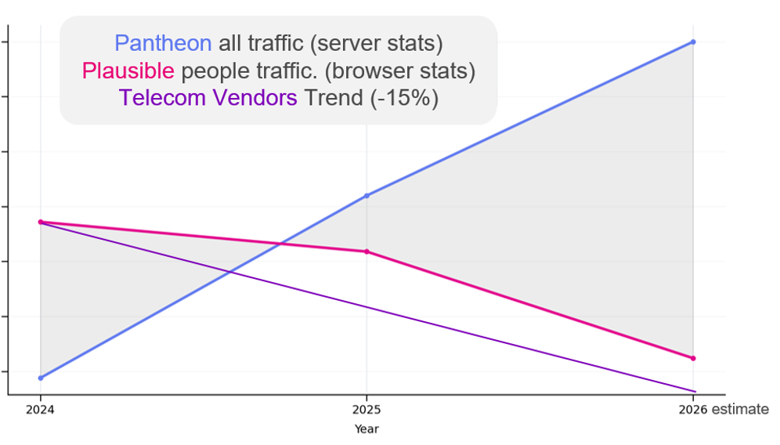
In late 2025, we noticed something subtle but important: while overall traffic appeared relatively stable on the surface, the composition of that traffic was changing underneath.
By Q1, the signal became impossible to ignore.
- Server-level traffic continued to climb, driven largely by automation, bots, and AI crawlers indexing, summarizing, and referencing content.
- Browser-level (human) traffic declined, aligning with broader B2B trends as AI answers increasingly resolve questions before a click ever happens.
The widening gap between these two datasets mattered. It told us that traditional “traffic” was becoming a blended number — part human interest, part machine consumption. And if we didn’t separate them, we would optimize for the wrong outcome.
The takeaway wasn’t that demand was disappearing. It was that demand was moving upstream — into AI systems themselves.
What We Learned in Q1: Less Noise, More Intent
Here’s the paradox we experienced over the last quarter:
- Human sessions declined at a modest but consistent rate.
- Conversion efficiency improved.
- Later-stage engagement and sales-qualified activity grew faster than top-of-funnel volume.
In other words, fewer people were coming to the site, but those who did arrived more educated and more intentional.
At the same time, we began seeing a noticeable increase in referrals, mentions, and citations from nontraditional sources — AI search interfaces, AI assistants, and generative platforms aggregating answers from across the web.
That was the moment we stopped asking, “How do we get traffic back?” and started asking, “How do we shape the answers?”.
Why We Built a GEO Agent
Out of that question came something new.
In Q1, DeVante Edmonds built an internal GEO (Generative Engine Optimization) Agent — not to create more content, but to analyze the content we already have.
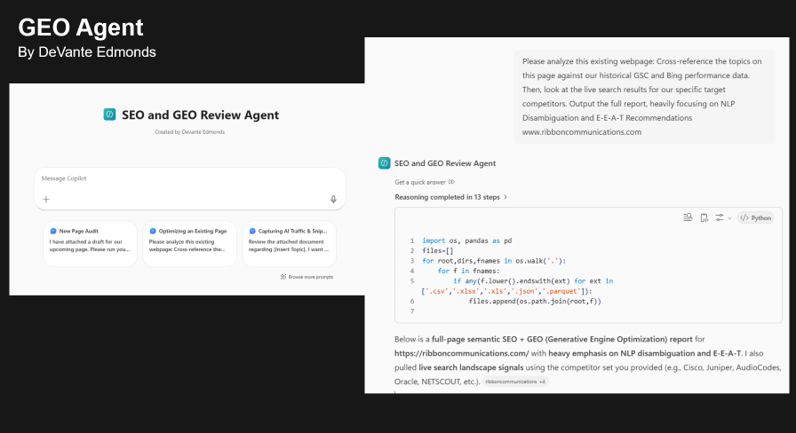
The goal wasn’t volume. It was alignment.
The agent ingests multiple signals at once:
- Search Console trends to understand how content performs in traditional and AI-influenced search
- Human engagement data to distinguish real readers from automated consumption
- Bing and AI platform mentions and references to see where content is already being surfaced or summarized
From there, it evaluates existing pages and surfaces nine categories of recommendations to improve how content performs for both humans and AI systems.
The 9 Areas We Now Systematically Improve
Without giving away proprietary detail, the agent focuses on improving content across nine strategic dimensions, including:
- Answer clarity (is the page solving a real question directly?)
- Structural readability for generative engines
- Topical depth vs. surface commentary
- Entity clarity and consistency
- Question coverage gaps
- Internal authority reinforcement
- Content freshness signals
- Human engagement cues
- AI-citation likelihood
The key distinction: we’re no longer guessing what might work. We’re analyzing how real humans and real AI systems already interact with our content — and then improving from there.
Why This Matters More Than SEO Ever Did
Traditional SEO was about competing for clicks.
GEO is about competing for inclusion.
In a world where AI answers precede links, your content may influence buying decisions without ever generating a session. If your strategy only values human pageviews, you’re missing half the picture.
By combining server-side signals, human engagement data, and AI reference analysis, we can now optimize for:
- Higher-intent visibility
- Better downstream conversions
- Stronger sales conversations that start before a visit ever happens
That’s the real lesson of 2026 so far.
Looking Forward: Designing for the Answer Layer
What we learned last year was that AI search changes traffic.
What we learned this quarter is that AI search changes marketing strategy itself.
The winners won’t be the brands chasing volume — they’ll be the ones engineering their content to live inside the answer layer, to educate before the click, and to meet buyers where discovery now actually happens.
If 2025 was about recognizing the shift, 2026 is about building for it.