
Muse Software Apps

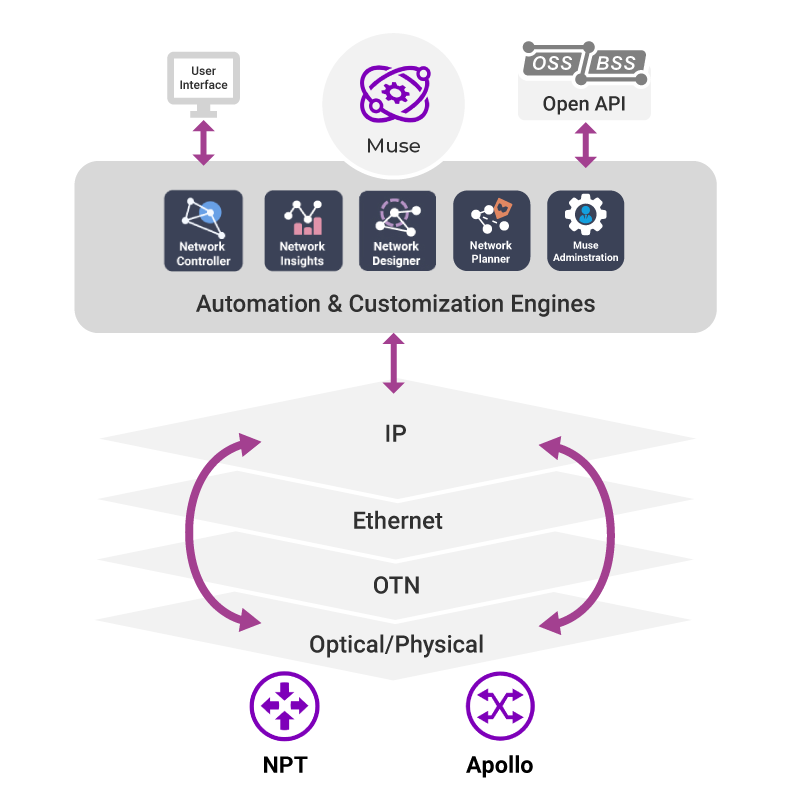
Network Controller
Real-time network control system for topology, commissioning, service deployment, fault management, maintenance, & automation.
Technical Features:
- Service Provisioning
- IP/MPLS + Optical Transport Layer
- Network Element/Turn-up
Commissioning - Network View
- Multilayer Fault Correlation

Network Insights
Self-service Business Intelligence application for evaluating network inventory, performance, utilization, & various key performance indicators.
Technical Features:
- Dashboards & Reports
- Trends
- Analysis
- Inventory Tracking

Network Designer
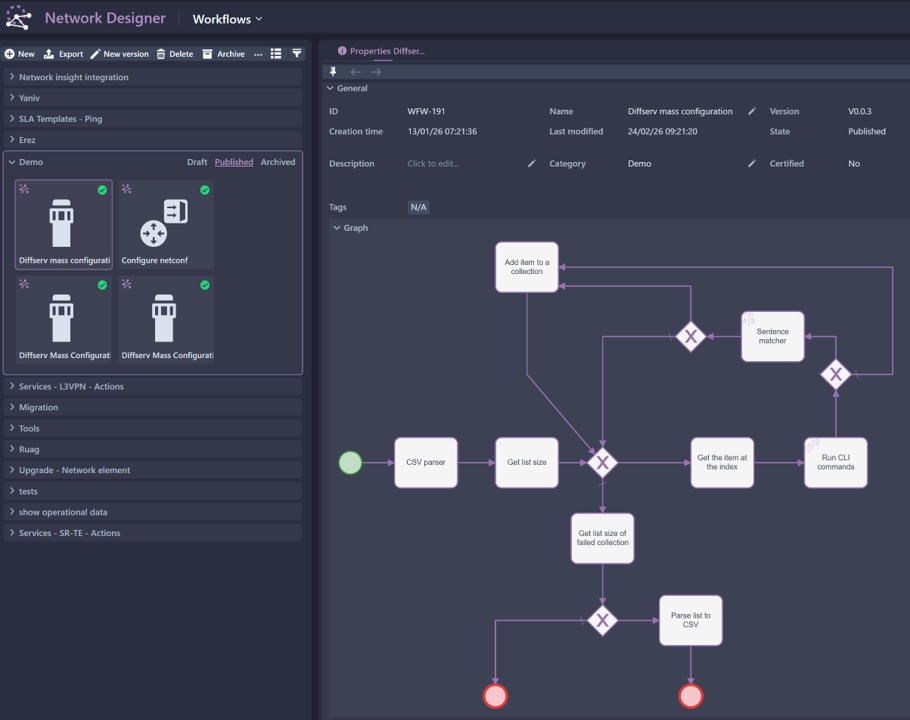
Low-code UI application for creating service templates, network components, tasks, and automation workflows.
Technical Features:
- Service Templates
- Network Elements
- Designer Workflow
- Automation

Network Planner
A network planning tool for designing and optimizing topology, optical services, and equipment allocation, with the capability to export all necessary reports.
Technical Features:
- Topology Planning
- Optimization Algorithms
- Service Demands and Restorations

Muse Administration
Management of the Muse applications suite, including user admin, authentication and authorization processes, licensing, and system performance monitoring.
Technical Features:
- Security Settings
- Application Backups
- System Health & Logs
Why Ribbon?
Muse Value Propositions
Multi-Layer Topology
Challenge
How to correlate my IP and Optical Layers?
Muse Benefits
Muse unifies IP routing and optical connectivity into a single topology view, improving visibility and accelerating troubleshooting.
Network Insights
Challenge
Move from Reactive to Proactive operations
Muse Benefits
Muse Network Insights analyzes inventory, performance, and utilization to enable reporting, trend analysis, and automation that improve CapEx efficiency and NOC operations.
Intent-Based Provisioning
Challenge
How to streamline the provisioning of new services.
Muse Benefits
Intent‑based provisioning standardizes service templates to speed service launch and reduce human errors.
Workflow Automation
Challenge
Muse Benefits
Workflows automate Network Operations Center (NOC) tasks—manual or scheduled—to streamline troubleshooting, maintenance, and large‑scale operations while reducing errors and costs.
Muse AI-Powered Agent
Challenge
How to simplify network management queries using natural language
Muse Benefits
Ribbon’s Muse Agent brings AI-assisted, conversational network management to Muse, delivering contextual answers based on Muse data and documentation.
Self-Service Multivendor
Challenge
Muse Benefits
Muse Demos
Perspectives

Accelerate Your Network Automation with Muse Automation Platform
This blog post summarizes how Muse leverages low-code platforms to streamline and automate network operations to drive profitability in IP Optical Networks.

AI-Enabled Network Management: Revolutionize Operator Workflows with AI Agents
This blog post discusses how conversational AI can be integrated into your unique network environment.

Accelerate Network Automation with No-Code / Low-Code Tools
This webinar hosted by Analysys Mason explores the network automation market and how Muse addresses key challenges operators face.
Featured Resources

Muse Multilayer Automation Platform Overview White Paper
This 30-page whitepaper provides a detailed overview of the Muse Multilayer Automation Platform including top value propositions and details of the key Muse software components.

Muse Multilayer Automation Platform Brochure
This 5-page brochure provides a high-level overview of the Muse Multilayer Automation Platform.

Muse Network Controller Brochure
This 7-page brochure provides a high-level overview of the Muse Network Controller

Muse Network Planner Brochure
This 2-page brochure provides a high-level overview of the Muse Network Planner.

AI-Powered Agent for Muse Network Management
Ribbon’s Muse Agent brings conversational, AI-assisted network management to Muse. Operators can ask questions in natural language and get guided, contextual answers—grounded in Muse data and product documentation.
Customer Stories


Resources
Solution Brief
AI-Powered Agent for Muse Network Management Muse Multi-Vendor Orchestration Muse Service Provisioning with Optimized Link Utilization SolutionBrochure
Muse Multilayer Automation Platform IP Optical Networking for Service Provider Networks Muse 5G Native Domain Orchestration Muse Analytics Muse Carrier-Grade Platform (PaaS) Muse Network Controller Muse Network Planner Muse SDN Domain Orchestration for Service AutomationApplication Note
Muse Automated Service Provisioning

Muse FAQs
What is SDN orchestration?
SDN orchestration is the coordination of network services, resources, and workflows across multiple network layers using software-defined control. In telecom transport networks, the Muse Multilayer Automation Platform provides SDN orchestration by acting as a multi-layer domain controller for IP/MPLS and optical networks, enabling centralized lifecycle management across planning, provisioning, assurance, and restoration.
How does SDN orchestration work?
SDN orchestration works by translating service intent into coordinated actions across network layers. Muse maintains a multi-layer topology view of IP and optical resources and applies templates, policies, and workflows to coordinate planning, commissioning, provisioning, and assurance, while integrating with OSS/BSS systems through northbound interfaces.
What is the difference between SDN orchestration and network orchestration?
Network orchestration refers broadly to coordinating network operations, while SDN orchestration applies software-defined principles such as centralized control, abstraction, and programmability. Muse delivers network orchestration using SDN architecture, enabling service providers to manage IP and optical networks through policy-driven, multi-layer automation.
What is the difference between SDN and NFV orchestration?
SDN orchestration focuses on coordinating network connectivity and transport behavior, while NFV orchestration manages virtualized network functions. Muse is designed for transport SDN orchestration of IP and optical networks and can integrate with higher-level orchestration systems that coordinate SDN and NFV together.
What problems does an SDN orchestration platform solve?
SDN orchestration platforms help service providers manage the complexity of multi-layer networks, reduce manual provisioning, improve visibility across IP and optical layers, and scale operations efficiently. Muse addresses these challenges by providing unified topology, automation, and lifecycle coordination across transport networks.
What are the benefits of SDN orchestration?
SDN orchestration improves service agility, reduces operational errors, enhances multi-layer visibility, and supports scalable network operations. Muse delivers these benefits by automating workflows and coordinating IP and optical resources through a centralized platform.